



Have Questions?
contact@vocesaac.com
A practical 1-hour conversation for SLPs navigating medical insurance funding for speech-generating devices.
We'll talk about clinical responsibility, working with AAC manufacturers and DME suppliers, funding documentation, ethical gray areas, and navigating the process without losing your clinical judgment.
Tuesday, October 20, 2026
6:00–7:00 PM PT
Live virtual training
Your registration includes:
1-hour live virtual training
Recording/replay
The live training will be held on Zoom.
After registration, you'll receive the Zoom link and training details by email. The replay and materials will also be sent by email after the live session.
Can't attend live? No problem—the replay is included with your registration.
Please provide the email you would like zoom link to be sent.
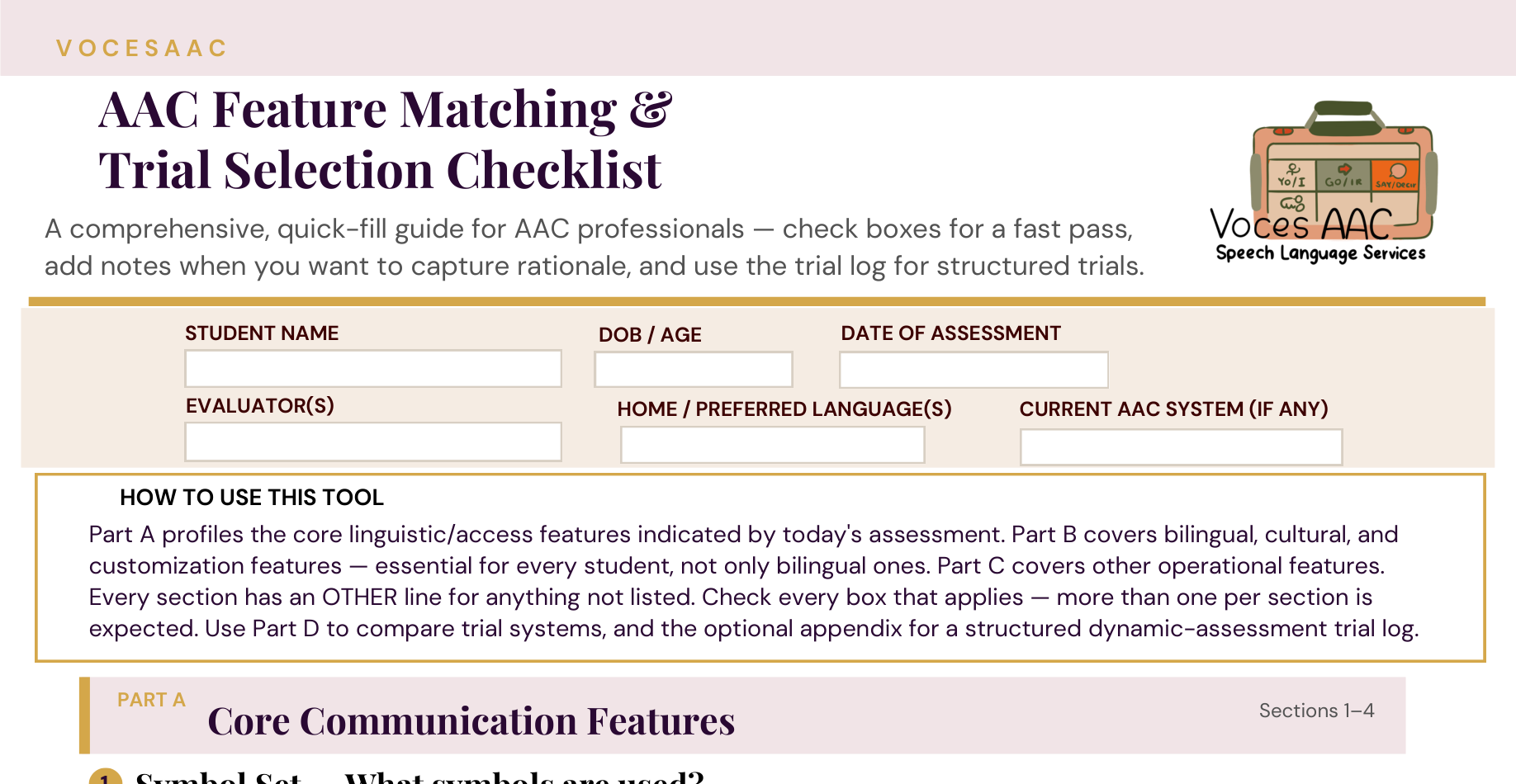
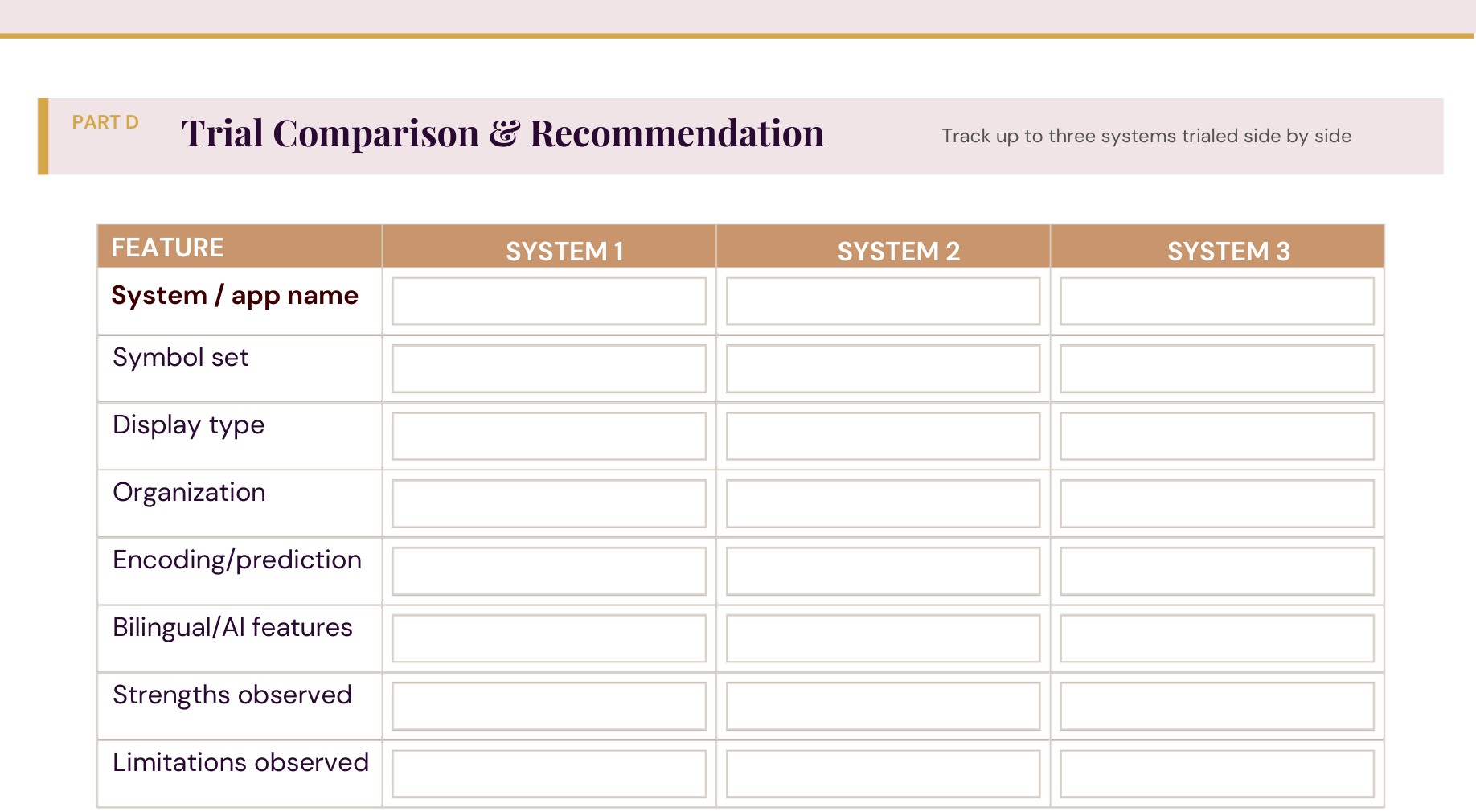
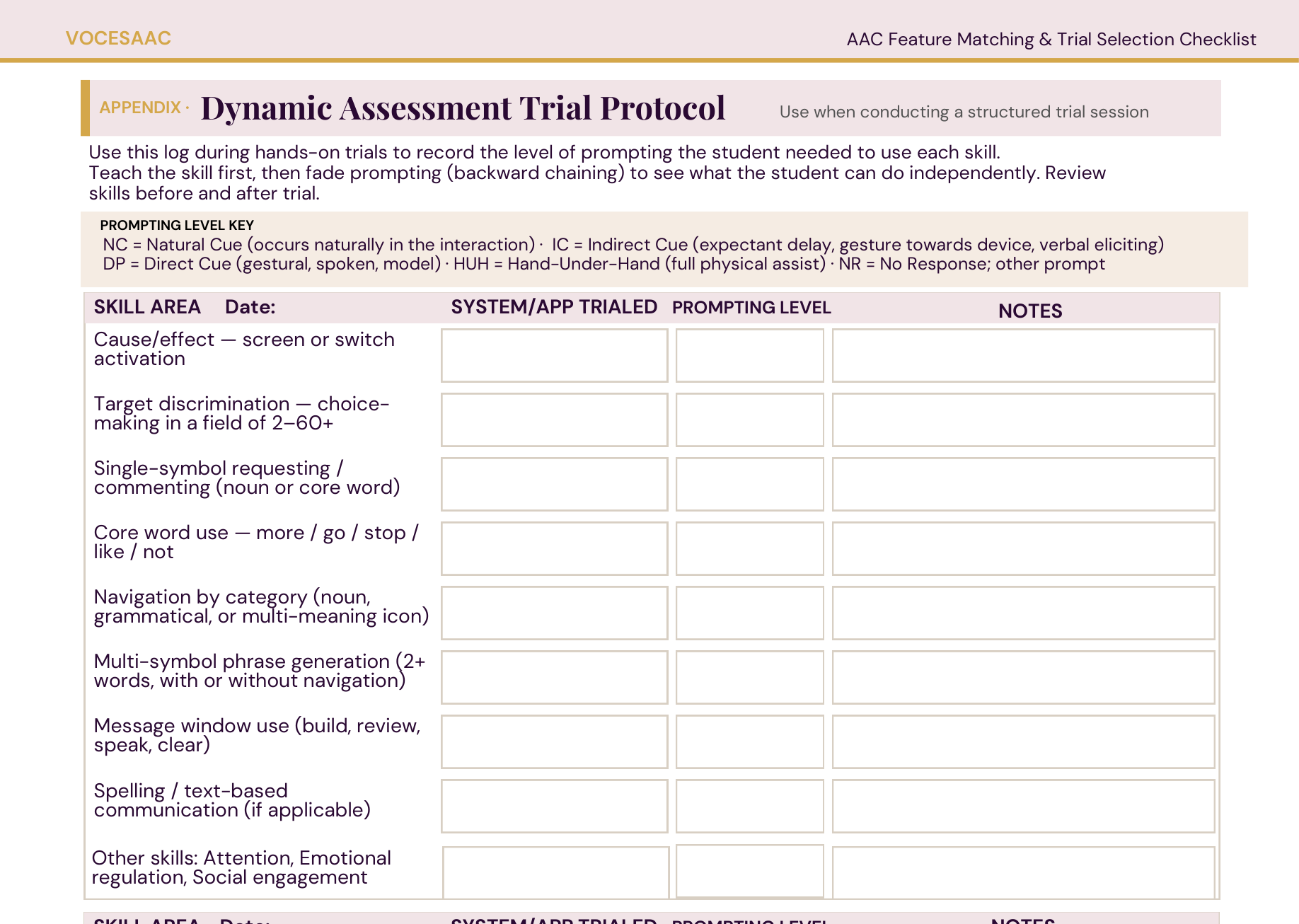
This 8-page checklist walks you through the full picture — symbol set, display type, organization, encoding and access — so you can match a student to the right AAC system with confidence, not guesswork.
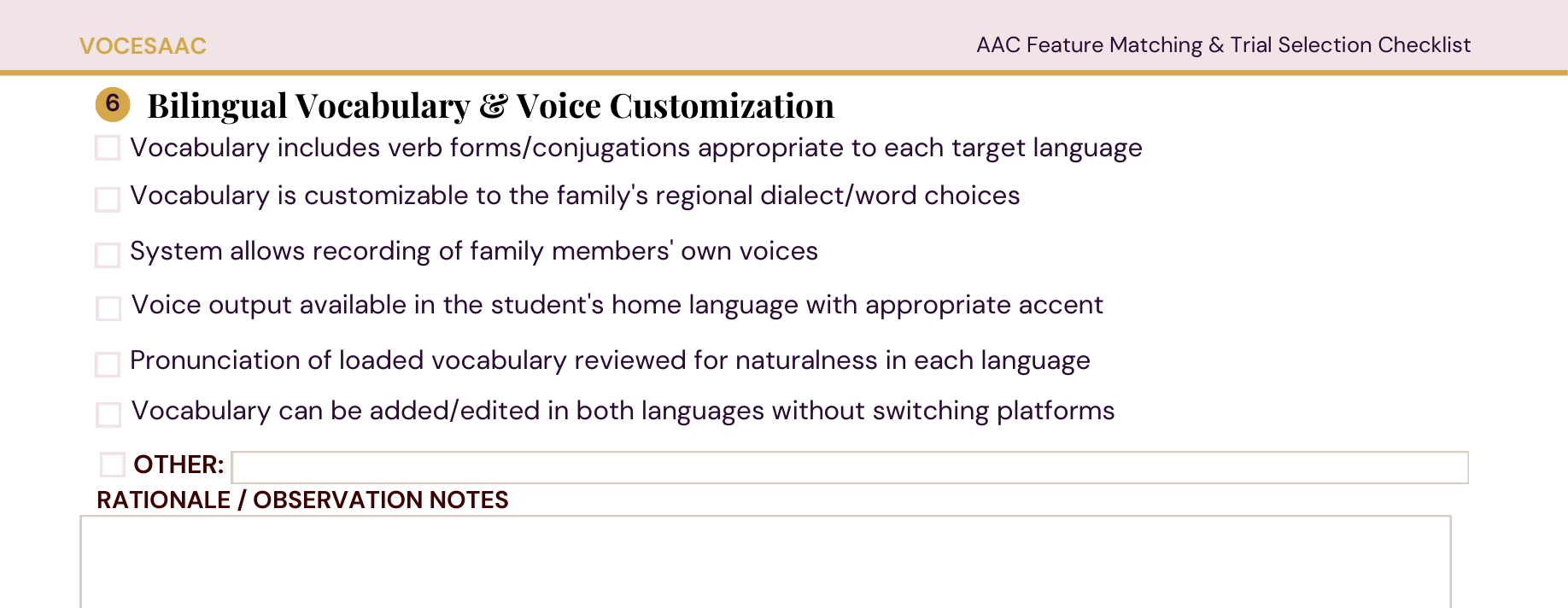
But here's what most trial-selection tools miss: cultural and linguistic responsiveness isn't a "bilingual add-on." It's essential for every student. That's why Part B is built into the core process, not tacked onto the end — covering family-confirmed language use, culturally reflective symbol sets, translation quality, and AAC AI-assisted features.
Inside, you'll find:
Parts A–C: Core communication features, bilingual/cultural/customization considerations, and operational logistics — all check-box fast, with space to capture your rationale
Part D: A side-by-side trial comparison grid for up to three systems
Appendix: A structured dynamic assessment trial log to track prompting level and skill progression across sessions
Built for AAC evaluators who want a tool that reflects how real families and real students actually communicate — not a one-size-fits-all form
4-week live AAC clinical training cohort focused on foundational AAC assessment and intervention, evidence-based implementation, communication partner strategies, and case-based clinical reasoning.
Includes:
4 live Zoom sessions
replay access for 60 days
downloadable resources
clinical case studies
6 professional development hours
certificate of completion
Limit 12 Participants.
After June 10, 2026 Regular registration:
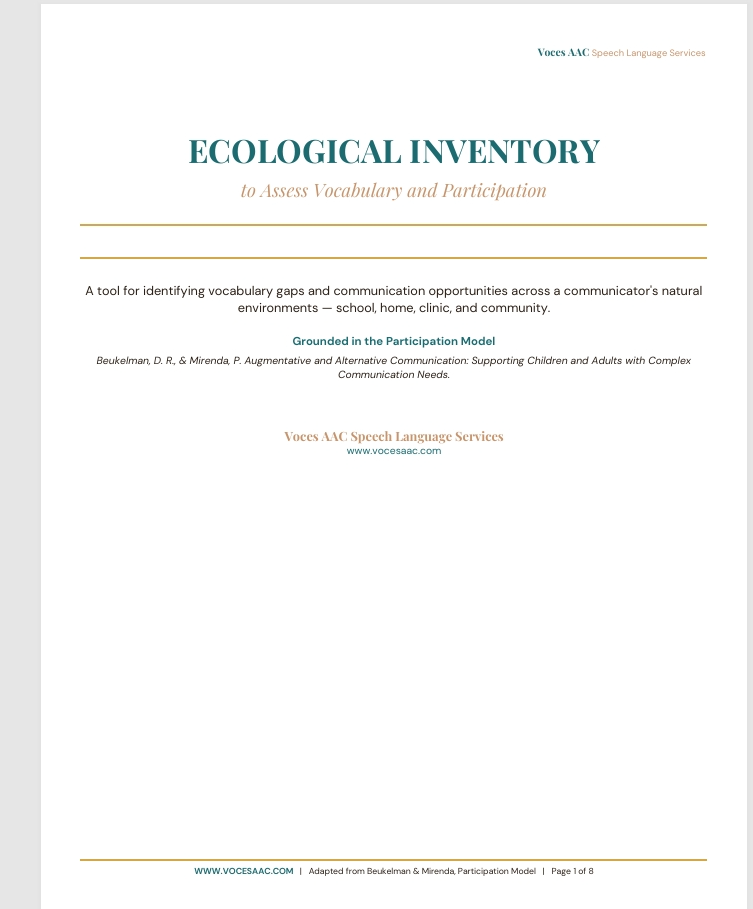
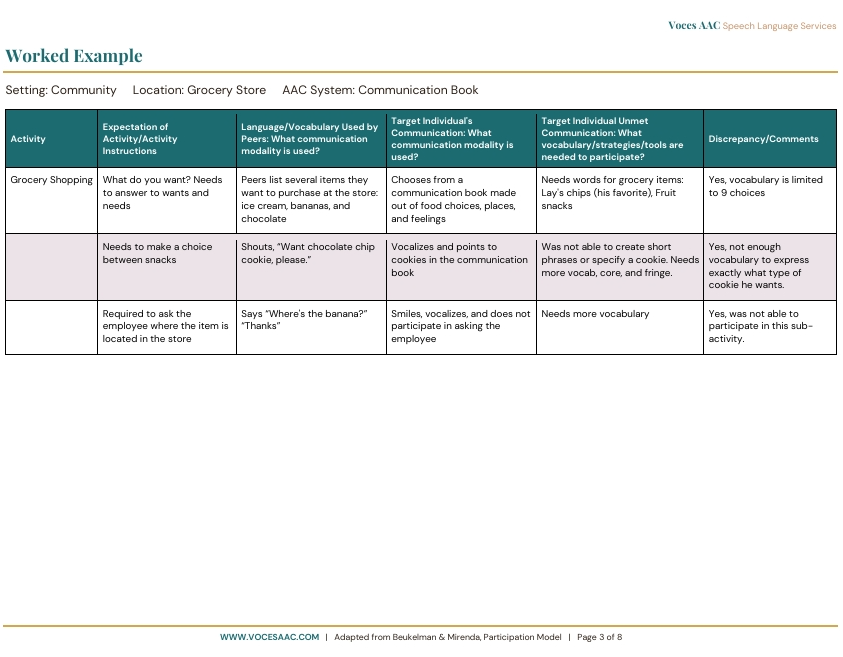
A field-tested tool for finding exactly what vocabulary your AAC learner needs — grounded in the Participation Model.
Your student has a device, but they're still sitting on the sidelines of the conversation — not because they can't communicate, but because the vocabulary they need for that activity isn't there yet. This inventory gives you a structured way to compare a peer's language in an activity to your learner's, and walk away with a clear, documented list of exactly what's missing.
How-to-Use guide with a results-interpretation section
3 worked examples — community, school, and home
2 blank templates, 6 activities each
Action Plan & Notes page to turn findings into next steps
Editable Word document (.docx and .doc) — type into the tables or print and complete by hand.
$4
Adapted from Beukelman & Mirenda's Participation Model. A Voces AAC Speech Language Services resource.t.
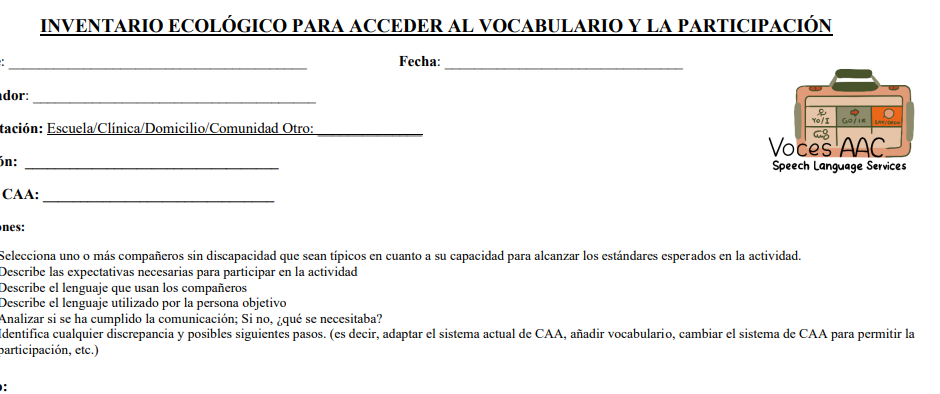
El Inventario Ecológico para Acceder al Vocabulario y la Participación es una herramienta de evaluación que incluye un ejemplo guía y espacios designados para que usted pueda evaluar a su propio estudiante. Permite identificar vocabulario funcional y significativo, así como oportunidades de participación dentro de los entornos y rutinas cotidianas. Este recurso apoya la planificación individualizada de CAA al facilitar la selección de palabras y apoyos de comunicación relevantes para promover el acceso, la participación y la autonomía comunicativa.

Initially, AAC implementation progress may appear subtle; sometimes the signs are unconventional, or we might not be observing closely enough. Here is a Checklist with several signs in attention, social engagement, operational skills, among others, not to miss!
Al principio, el progreso en la implementación de la CAA puede parecer sutil; a veces, las señales son poco convencionales o tal vez no estamos observando con la suficiente atención. Aquí presentamos una lista de verificación con diversas señales —relacionadas con la atención, la interacción social, las habilidades operativas, entre otras— que no debe pasar por alto.

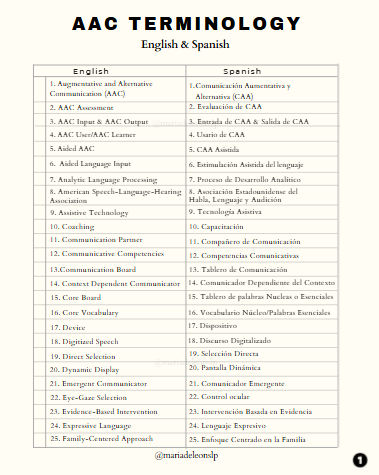
This is a list of 75 AAC Terms in English and Spanish—a quick guide for translations in IEP meetings and a guide for interpreters/translators.
Esta es una lista de 75 términos de CAA en inglés y español. Una guía rápida para traducciones en las reuniones del IEP y una guía para intérpretes/traductores.


This mapping tool can serve the IEP team identify a student’s daily classroom activities (i.e., arrival, circle time, reading, recess, lunchtime, show and tell, etc.) along with the identified communication strategies that will be provided to the student during the classroom activity.
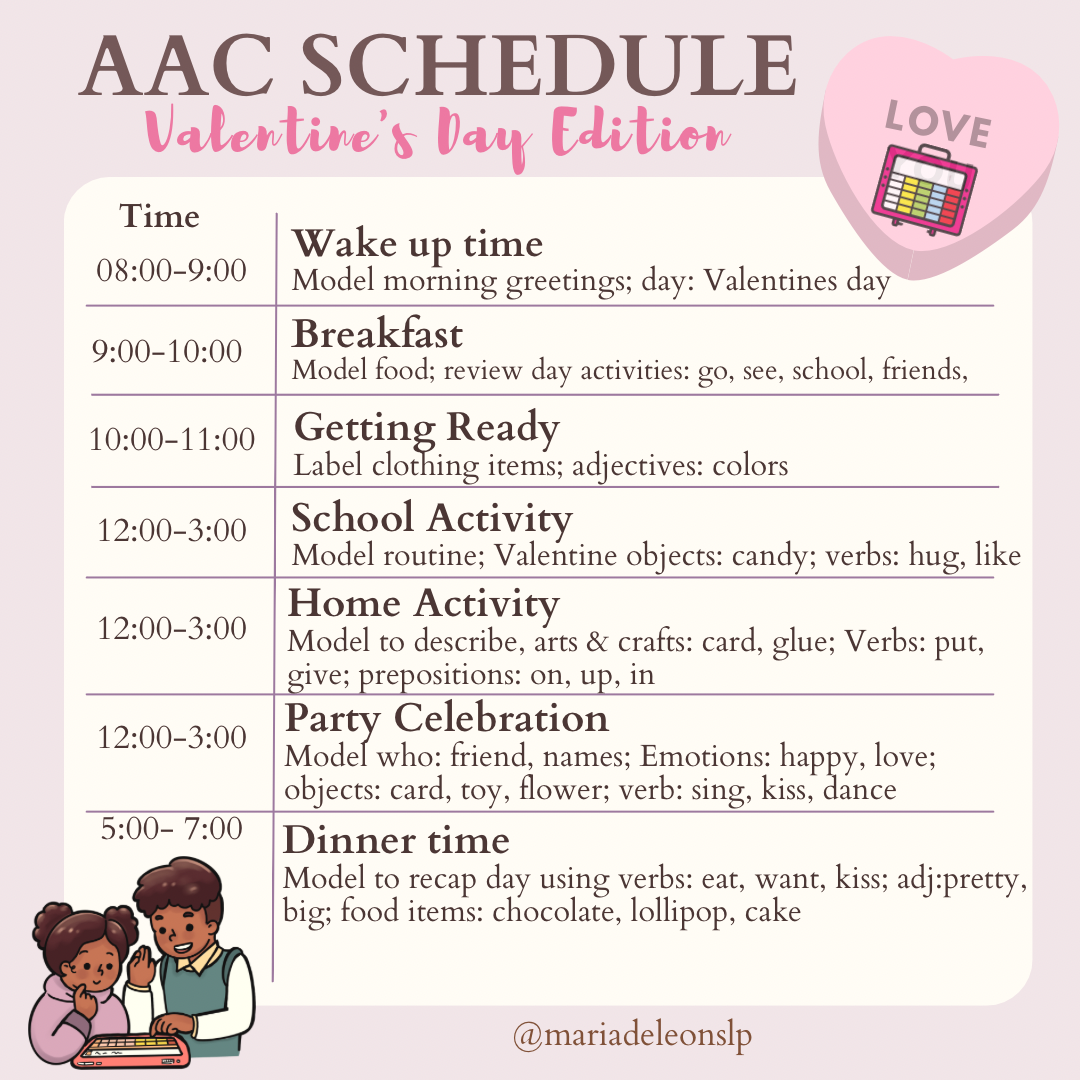

Free Digital download: English and Spanish
This schedule aims to highlight the following:
1. Modeling is an essential strategy for teaching and learning AAC.
2. Modeling is most effective when we do it at every chance and in different environments. It should be natural how we talk with our vocal speech.
3. When selecting vocabulary/targets to model, we should focus beyond only requesting. For example, we can comment, describe, label, etc.
4. When selecting vocabulary or phrases to model, we want to use a variety of nouns, verbs, adjectives, prepositions, quantifiers, etc. and make sure we are modeling those in different contexts.
No results match your search. Try removing a few filters.
contact@vocesaac.com